
Preparing for EASA ATPL theoretical knowledge exams involves more than studying 13 subjects. Students must also follow specific examination rules covering minimum scores, the number of attempts, examination sittings and the deadline for completing the entire set of exams.
Understanding these limits before taking your first examination is important. Failing to complete the exams within the permitted limits can mean having to repeat the entire set, including subjects you previously passed.
Quick answer: Under EASA Part-FCL, ATPL theoretical knowledge candidates must achieve at least 75% in each examination paper, pass each subject within a maximum of four attempts, and complete all required examinations within six sittings and 18 months. The 18-month period is counted from the end of the calendar month in which the first examination was attempted. Exceeding any of these limits requires retaking the entire examination set after additional training.
What are the EASA ATPL exam rules?
The main EASA ATPL examination rules are established in FCL.025 of Annex I (Part-FCL) to Commission Regulation (EU) No 1178/2011.
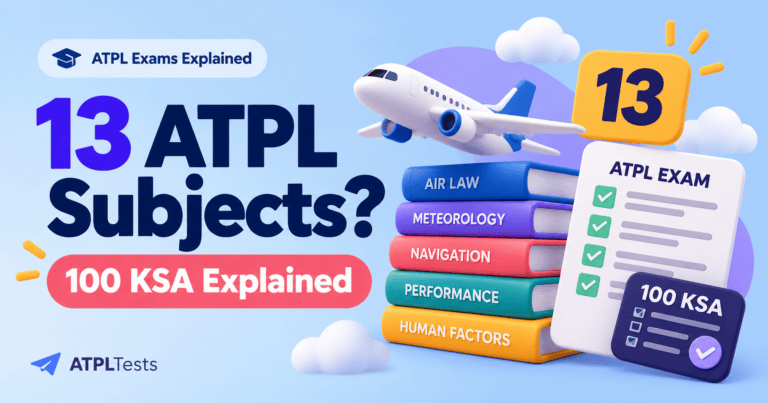
Before planning your examination sittings, it is important to understand which subjects you need to pass. See our guide to the 13 EASA ATPL theoretical knowledge exams, including the difference between the 13 examination subjects and Area 100 KSA.
These requirements establish how candidates complete theoretical knowledge examinations for professional pilot licences and ratings.
The following table summarises the principal requirements applicable to EASA ATPL theoretical knowledge examinations.
| Requirement | EASA ATPL rule | Legal reference |
|---|---|---|
| Minimum pass mark | 75% in each examination paper | FCL.025(b)(1) |
| Maximum attempts | 4 attempts per subject | FCL.025(b)(3) |
| Maximum sittings | 6 sittings for the complete examination set | FCL.025(b)(3) |
| Completion deadline | 18 months from the end of the month of the first attempt | FCL.025(b)(2) |
| Exceeding a limit | Retake the complete examination set after further training | FCL.025(b)(3) and (5) |
| Negative marking | No penalty marking | FCL.025(b)(1) |
These requirements apply to the theoretical examination process. Individual competent authorities may establish their own booking procedures, examination calendars and administrative arrangements within the applicable European framework.
The full legal text is available in Commission Regulation (EU) No 1178/2011, Annex I, FCL.025.
What is the ATPL exam pass mark?
The minimum pass mark for an EASA ATPL theoretical knowledge examination is 75% of the marks allocated to that examination paper.
This requirement applies individually to each examination subject. A high score in one subject cannot compensate for failing another.
For example, a candidate obtaining 82% in Meteorology and 73% in Air Law has passed Meteorology but failed Air Law.
The candidate would need to retake Air Law within the applicable attempt, sitting and time limits.
EASA also specifies that no penalty marking shall be applied. Incorrect answers do not attract an additional negative-marking deduction.
However, the absence of penalty marking does not reduce the required 75% pass standard.
How many attempts are allowed for each ATPL exam?
An EASA ATPL candidate has a maximum of four attempts to pass each theoretical knowledge examination paper.
An attempt is a try to pass a particular examination paper.
If a student fails General Navigation on the first attempt, they may attempt the subject again, provided they remain within the examination limits.
The maximum of four attempts applies separately to each subject, rather than to the entire set of ATPL examinations.
For example, a student could pass Air Law on the first attempt, Meteorology on the second and General Navigation on the third, without exceeding the attempt limit for any individual paper.
However, under the applicable examination arrangements, only one attempt at a particular paper is permitted within the same sitting.
What happens after four failed attempts?
If a candidate fails a required ATPL subject in four attempts, FCL.025(b)(3) requires the candidate to retake the entire set of theoretical knowledge examination papers after additional training.
Previously passed subjects do not remain sufficient to complete that failed examination set.
What is an ATPL exam sitting?
An ATPL exam sitting is an examination period established by the competent aviation authority during which a candidate can take one or more theoretical knowledge examination papers.
A sitting is not necessarily the same as an individual subject examination or a single calendar day.
EASA Guidance Material GM1 FCL.025 explains that a sitting should not exceed 10 consecutive days. Only one attempt at each examination paper is permitted within one sitting.
This means a student may take several different ATPL subjects within a single sitting, depending on the available examination arrangements.
For example, taking Air Law, Meteorology and Human Performance during one defined sitting counts as one sitting, not three separate sittings.
The precise dates and organisation of each examination period are determined by the relevant competent authority.
Students should therefore check the examination calendar and sitting rules published by the authority responsible for their examinations before making a booking.
How many sittings are allowed for EASA ATPL exams?
EASA ATPL candidates must complete the entire theoretical knowledge examination set within a maximum of six sittings.
This rule applies alongside the separate limit of four attempts per subject and the overall 18-month completion period.
The six-sitting rule does not mean students must take all 13 subjects in exactly six examination days. A sitting can cover several examinations across the examination period established by the authority.
Students can distribute subjects across their sittings, subject to their authority’s arrangements and the remaining attempt and time limits.
For example, a candidate might complete several subjects during an early sitting and reserve later sittings for more demanding examinations or necessary retakes.
This is a planning choice, not an EASA requirement to sit particular subjects together.
If a candidate has not passed the complete examination set within six sittings, the entire set must be retaken after the required additional training.
When does the 18-month ATPL exam period start?
The EASA ATPL 18-month examination period is counted from the end of the calendar month in which the candidate first attempted a theoretical knowledge examination paper.
It does not begin when the student starts ground school, registers for an online question bank or receives an initial training plan.
For example, suppose a student takes their first ATPL theoretical examination on 10 January 2026.
The relevant starting point for the 18-month period is the end of January 2026, not 10 January itself.
| Event | Example date |
|---|---|
| First ATPL exam attempt | 10 January 2026 |
| End of the starting calendar month | 31 January 2026 |
| 18-month completion deadline | 31 July 2027 |
In this example, all required ATPL examination papers must be passed within the applicable 18-month period, while also respecting the four-attempt and six-sitting limits.
Failing an examination does not restart the 18-month clock. Neither does taking a break from exams or beginning another sitting.
For administrative certainty, candidates should confirm their recorded first-attempt date and final completion deadline with their competent authority.
What happens if you fail an ATPL exam?
Failing one ATPL examination paper does not automatically mean having to restart the entire ATPL theory examination set.
A candidate who has not exhausted the applicable limits can usually retake the failed paper in a later sitting.
For example, if a student fails Performance on their first attempt, they may attempt Performance again within their remaining opportunities.
However, there are three important situations in which EASA requires a complete examination reset.
- Four unsuccessful attempts: a required paper has not been passed within four attempts.
- Six-sitting limit: the complete set has not been passed within six sittings.
- 18-month deadline: the complete set has not been passed within the permitted completion period.
If any of these limits is reached without successfully completing the required examination set, FCL.025(b)(3) requires the candidate to retake the complete set of examinations.
This means that passing 12 of the 13 subjects does not protect those results from the requirement to repeat the complete set if the remaining subject is not passed within the permitted limits.
Do you need additional training before restarting ATPL exams?
Yes. FCL.025(b)(5) requires further training before a candidate retakes the complete theoretical knowledge examination set after exceeding the applicable limits.
For ATPL candidates, this normally involves the Approved Training Organisation (ATO) responsible for the relevant training arrangements.
The applicable regulation provides that the extent and scope of the additional training are determined by the training organisation on the basis of the candidate’s needs.
This does not necessarily mean repeating an identical complete theoretical knowledge course in every case. The required additional training must be determined according to the applicable rules and the candidate’s circumstances.
The candidate must then follow the competent authority’s procedure for admission to a new complete examination set.
Do you need an ATO recommendation before taking ATPL exams?
Yes. Before taking the theoretical knowledge examinations, candidates must have the required recommendation from the training organisation responsible for their course.
Under FCL.025(a), the recommendation is issued after the candidate satisfactorily completes the appropriate theoretical knowledge training elements.
The recommendation is normally valid for 12 months.
If the candidate does not attempt at least one theoretical knowledge examination paper within that validity period, the training organisation must determine whether further training is necessary.
For professional pilot training, EASA also provides specific Acceptable Means of Compliance concerning completion of the applicable Area 100 KSA assessments and mental maths test before a candidate is recommended to attempt the final theoretical examination paper for the first time.
The recommendation validity period is a separate requirement from the 18-month period for completing the examinations.
How long are passed ATPL theoretical exams valid?
Successful completion of the EASA ATPL theoretical knowledge examinations remains valid for the issue of an ATPL for seven years from the last validity date of an Instrument Rating (IR) entered in the licence.
For helicopters, FCL.025(c)(2) also provides the relevant rule concerning the last validity date of a helicopter type rating entered in the licence.
This is different from the 18-month examination completion period.
The 18-month period concerns how long a candidate has to pass the complete examination set after the first attempt.
The seven-year provision concerns the subsequent validity of completed ATPL theoretical knowledge examinations for the issue of the ATPL, with the reference date linked to the applicable rating rather than simply the day of the final theory examination.
For comparison, FCL.025(c)(1) provides a 36-month theoretical examination validity period for the issue of a CPL, MPL or IR, measured from successful completion of the examinations.
Therefore, students should not assume that every pilot licence or rating has the same theoretical examination validity period.
The official conditions are set out in FCL.025(c) of Part-FCL.
Can you take EASA ATPL exams in different countries?
FCL.025(a)(1) requires candidates to complete the entire theoretical knowledge examination set for a particular licence or rating under the responsibility of the same Member State’s competent authority.
This means students cannot simply divide their examination set between several different EASA national authorities without regard to the applicable regulatory and administrative requirements.
Before registering for an ATPL examination programme, candidates should confirm which competent authority will be responsible for their complete examination set.
The examination venue or booking arrangements should not be confused with the identity of the authority responsible for the examinations.
This article concerns EASA Part-FCL. Students taking examinations administered by the UK Civil Aviation Authority should consult the applicable UK CAA requirements separately.
How do ATPL exam rules work in Poland?
In Poland, theoretical knowledge examinations are administered by the Polish Civil Aviation Authority, commonly known as the Urząd Lotnictwa Cywilnego (ULC).
The Polish CAA confirms the main EASA requirements for professional pilot theoretical examinations, including the 75% pass mark, the four-attempt limit, six sittings and the 18-month completion deadline.
The authority also specifies that a candidate may use only one attempt at a particular subject during a given examination session.
ATPL, CPL and IR theoretical examinations in Poland are conducted in English using the applicable European Central Question Bank.
Before planning an examination sitting in Poland, candidates should consult the authority’s current calendar, admission requirements and examination procedures.
Official information: Polish CAA – Examination attempts and pass requirements.
How should students plan their ATPL examination sittings?
A sensible ATPL examination plan should account for all three limits: four attempts per paper, six sittings and 18 months for the complete examination set.
Starting the examination period before being adequately prepared can create unnecessary pressure, especially if several subjects remain incomplete near the deadline.
Students can reduce avoidable examination risk by preparing a realistic subject schedule before the first attempt and allowing sufficient time for revision and possible retakes.
It is also useful to distinguish between subjects that require extensive calculations and those that involve a larger amount of regulatory or procedural knowledge.
Practice Sessions can help identify weak topics before the official examinations, while Mock Exams can provide an opportunity to practise answering questions under timed conditions.
Students preparing across the full syllabus can review the ATPL Tests EASA ATPL question bank and our comparison of ATPL question banks.
The aim is not simply to complete as many practice questions as possible. It is to understand the material well enough to pass the required subjects within the permitted examination limits.
Frequently asked questions about EASA ATPL exam rules
What percentage do you need to pass an EASA ATPL exam?
The pass mark is at least 75% of the allocated marks in each examination paper. Each subject must be passed individually, and EASA does not apply penalty marking for incorrect answers.
How many times can you fail an ATPL subject?
You have a maximum of four attempts to pass a required ATPL subject. If you do not pass within those four attempts, you must retake the entire examination set after completing the required additional training.
What is the maximum number of ATPL exam sittings?
Candidates must pass the entire ATPL theoretical examination set within six sittings. A sitting is an examination period established by the competent authority and may contain several different subject examinations.
When does the ATPL 18-month period begin?
The 18-month period is measured from the end of the calendar month in which the candidate first attempted a theoretical knowledge examination. It does not begin automatically when ground school starts.
What happens if you do not finish ATPL exams within 18 months?
If the complete examination set is not passed within the permitted 18-month period, FCL.025 requires the candidate to retake the entire set after further training. This applies even if several subjects were previously passed.
Can you take the same ATPL subject twice in one sitting?
No. EASA Guidance Material specifies that only one attempt at an examination paper is allowed within one sitting. A failed subject must be attempted again in a later sitting, subject to the remaining limits.
Do ATPL theory exams expire after 18 months?
No. The 18-month limit concerns completing the required examination set. Once the ATPL theoretical examinations have been successfully completed, the separate validity rule in FCL.025(c)(2) applies for the issue of the ATPL, linked to the last validity date of the relevant IR or, for helicopters, the applicable type rating.
EASA ATPL exam rules: the main points to remember
The EASA ATPL examination system imposes clear limits on marks, attempts, sittings and the period available to complete the examinations.
The main requirements are straightforward: at least 75% in each paper, no more than four attempts per subject, no more than six sittings and successful completion of the entire examination set within 18 months from the end of the month of the first attempt.
Candidates who exceed these limits must retake the complete examination set after further training.
Once the theory examinations are successfully completed, a separate validity period applies for the issue of the ATPL.
Understanding these distinctions before taking the first exam can help students prepare a more realistic examination schedule and avoid misunderstandings about the regulatory deadlines.
Official sources and regulatory references
This article focuses on EASA ATPL theoretical knowledge examination requirements under Annex I (Part-FCL) to Commission Regulation (EU) No 1178/2011.
The principal legal reference is FCL.025, which covers examination responsibilities, pass standards, examination completion limits and the validity of theoretical knowledge results.
The distinction between an attempt and a sitting is further explained in EASA Guidance Material GM1 FCL.025.
Official sources:
- EUR-Lex – Commission Regulation (EU) No 1178/2011, Annex I, FCL.025
- EASA – Aircrew regulations and Easy Access Rules
- Polish CAA – Examination pass requirements and attempts
- Polish CAA – Validity of theoretical and practical examinations
Regulations and national examination procedures may be amended. Candidates should consult the current official requirements applicable to their competent authority before making examination or licensing decisions.
Last reviewed: 25 October 2026.
Test your ATPL knowledge.
Try 10 Air Law questions for free, or create a free account to access the ATPL question bank.